Aluminum or steel robotic arms have one fundamental problem: weight. Heavier arms mean higher moving mass, which limits speed, acceleration, and positioning accuracy. High inertia forces motors to deliver more torque, increases energy consumption, and accelerates wear on gears and bearings. On top of that, metals expand and contract with temperature changes, compromising repeatable positioning accuracy in precision operations.
None of this is new. Automation engineers have been eyeing carbon fiber for years. But here's the hard truth: carbon fiber is not metal, and treating it like one is a guaranteed path to project failure. This isn't theory—it's a conclusion we've verified repeatedly on the shop floor.
Carbon fiber has a density roughly 60% that of aluminum alloy, with far superior specific strength. It directly reduces moving mass and improves response speed. Its coefficient of thermal expansion is extremely low (near-zero or even negative), ensuring dimensional stability under temperature variations—critical for precision applications. Carbon fiber also offers excellent vibration damping, effectively absorbing motion-induced vibrations to improve stability and reduce wear on motors and bearings.
These material advantages aren't secrets. The real challenge is translating them into a component that's manufacturable, scalable, and reliable in production. We've handled many similar requests—customers show up with metal-part drawings hoping for a "direct carbon fiber replacement." But carbon fiber's strength comes from fiber orientation. Layup direction must be designed according to actual load paths. Using metal drawings directly almost always leads to problems.
Connection points are another common pitfall. Without additional layup reinforcement around drilled holes and fastener areas, delamination during service is almost certain. And there's the tooling gap: soft tooling used for prototyping and steel tooling for production are entirely different animals. Draft angles and split lines that can be ignored in prototyping become hard requirements in mass production.
Our approach: start with engineering. We perform load analysis first, then propose layup schemes and material grading recommendations—T700 directional layup for load-bearing areas, T300 for non-critical zones to keep costs under control without sacrificing performance. Connection points get separate reinforcement. Tooling is developed directly for production conditions, avoiding the awkward situation where prototypes pass but production fails.
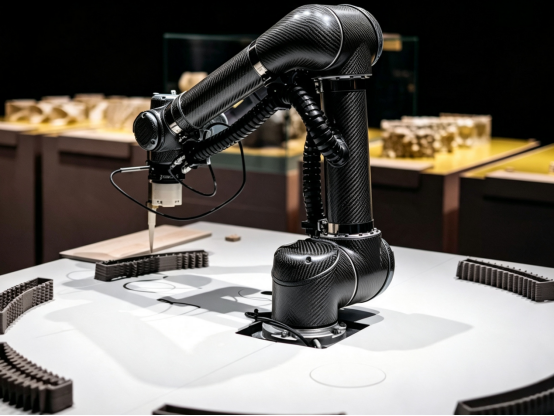
In metalworking, the gap between prototype and production is relatively narrow. Not so with carbon fiber.
Prototyping can use soft tooling, hand layup, and manual edge finishing—fast and low-cost. But none of these scale to production. Steel tooling requires draft angles, precise split lines, curing cycle timing, and CNC machining with specialized cutting tools and dust control—all issues that don't even exist at the prototype stage.
Many projects stall at "prototype works, but we can't make it at volume." To avoid this, the production plan must be considered from the prototype stage. Insufficient draft angles, unreasonable split lines, and connection points that can't be reliably machined are manageable in prototyping but disastrous in production.
With over 20 years of composite manufacturing experience, GBTECH provides full-service support from design assistance and engineering analysis to prototyping and mass production. Our capabilities include filament winding, compression molding, autoclave processing, pultrusion, and CNC finishing—all under ISO 9001 quality management.
The advantages of carbon fiber robotic arms go beyond weight—they deliver better dynamic response, thermal stability, and long-term reliability. But consistently realizing these advantages in production requires more than materials. It takes the ability to integrate materials, design, process, tooling, and machining into one complete system. That's experience, not just technology.
If you're evaluating carbon fiber replacement for metal structural components in robotic arms, or if you have a project moving from prototype to production, visit gbtechmaterials.com or reach out to our engineering team directly.
Official GBTECH Websites:
EMail: zane@gbtechgroup.cn
Phone: +1 (510)902-9987
www.gbtechgroup.cn | www.gbtechcomposites.com | www.gbtechmaterials.com
US.Office: 38758 Buckboard Common, Fremont, CA 94536, United States
China Head Quaters: Building 1, Left Side, Tangye Road, Xinxu, Huiyang, Huizhou, China


 WhatsApp
 E-mail